Crypto Casino Deposit Fees: Who Actually Charges Them?
If you are trying to fund a casino account with crypto, the short answer is this: the casino often may not charge a deposit fee, but you can still pay costs elsewhere in the transfer path.
If you are trying to fund a casino account with crypto, the short answer is this: the casino often may not charge a deposit fee, but you can still pay costs elsewhere in the transfer path.
In many cases, the money is taken by the blockchain network, your exchange, your wallet provider, a payment processor, or through conversion spread rather than by the casino itself.
That distinction matters because many players see a smaller received amount and assume the casino took a cut. Sometimes that is true, but often the real cause is the method used to buy, convert, or send the crypto in the first place.
This guide breaks down where crypto deposit costs actually come from, how to tell who charged them, and how to choose a deposit route with lower total cost.
Do Crypto Casinos Charge Deposit Fees or Do Third Parties?
Crypto casinos do not all handle deposits the same way. Some list crypto deposits as fee-free on their side, while others may apply fees in certain cases, such as specific payment rails, conversion steps, or minimum processing rules. But even when a casino says there is "no deposit fee," that does not always mean your full transfer is cost-free.
A deposit can involve several separate layers:
the casino cashier
the blockchain network
a crypto payment gateway or processor
your wallet
your exchange
a currency conversion spread
That is why a player can send funds, see less arrive, and still not be dealing with a casino-side fee at all.
If you are comparing funding options, it also helps to look at broader casino payment method comparisons rather than focusing only on the cashier label.
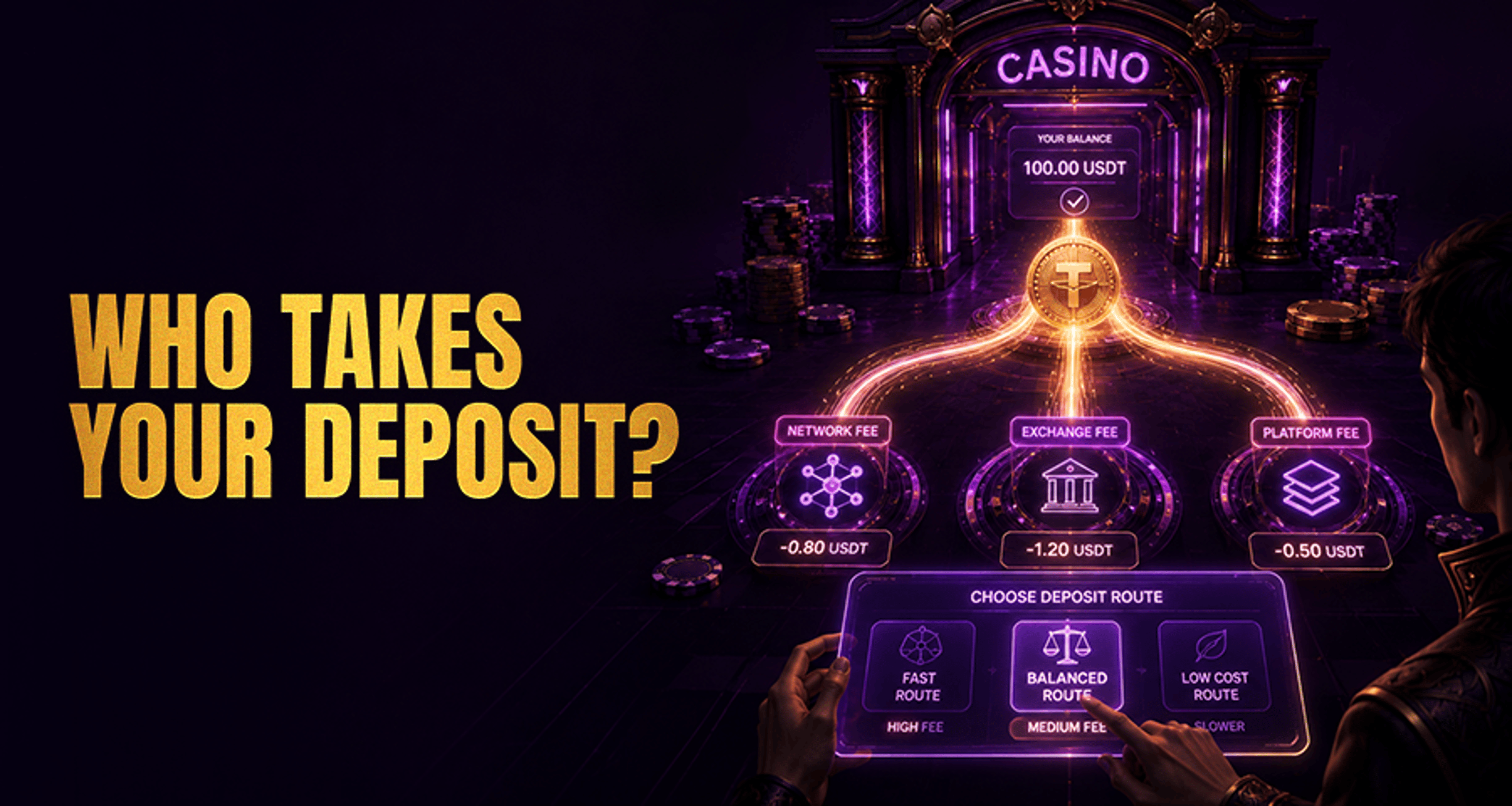
The 4 Places Deposit Costs Usually Come From
In practice, deposit costs usually fall into four main buckets, even though several companies or systems may be involved.
1. Casino-side deposit fees
This is the fee most players are looking for: a charge directly applied by the casino when it credits your deposit. Not every casino applies one, and many try to avoid doing so because deposit friction can drive players away.
If there is a true casino deposit fee, it is usually disclosed in the cashier, payments page, or terms for a specific method.
2. Blockchain network fees
This is one of the most common costs. When you send crypto on-chain, validators or miners process the transaction and the network fee is paid to the blockchain, not to the casino.
These fees are often variable. They can rise or fall depending on chain congestion, token standard, and timing. A busy network can make the same deposit route more expensive later in the day than it was earlier.
3. Third-party service fees
A payment gateway, wallet service, or exchange may charge a fee for moving funds. This often happens when you:
withdraw crypto from an exchange to the casino wallet
buy crypto with a card before depositing
use a processor that handles conversion behind the scenes
These fees are easy to mistake for casino charges because they happen immediately before the deposit reaches the casino.
4. Conversion spread
Sometimes there is no obvious line item called a fee, but you still lose value through conversion. This is common when you:
buy one asset and send another
convert fiat to crypto in a purchase flow
swap between coins before depositing
deposit through a processor that quotes its own exchange rate
The cost may show up as a worse rate rather than a separate deduction.
When the Casino Charges a Fee vs When the Network Does
The easiest way to understand responsibility is to separate platform fees from transfer fees.
A casino fee is typically a platform charge applied by the operator. A network fee is the cost of broadcasting and confirming the transfer on-chain. They are not the same thing, and they appear in different places.
Direct on-chain deposit
If you send crypto from your personal wallet straight to the casino deposit address, the most likely extra cost is the network fee. In that setup, the casino may credit exactly what it receives, while the blockchain fee is deducted from your wallet when you send.
Exchange withdrawal to casino wallet
If you send from an exchange, the exchange may charge a withdrawal fee before the funds even leave its platform. On top of that, the transfer may still reflect network conditions depending on how the exchange structures its withdrawal pricing.
This is one reason your sent amount and the casino's received amount may not match your expectations.
Card-to-crypto purchase flow
If you buy crypto with a bank card and then route it into a casino deposit flow, total cost can come from multiple places at once: card processing, provider markup, spread, and then transfer cost. In that scenario, the casino may still not be the one charging the main fee.
Stablecoin transfer
Stablecoin deposits can sometimes make costs easier to understand because the coin value is steadier, but they are not automatically cost-free. The network used still matters, and some platforms add withdrawal or conversion charges before the transfer is sent.
How Exchange, Wallet, and Conversion Fees Get Mistaken for Casino Fees
This is where players get confused most often.
You might think, "I sent $100 worth of crypto and the casino credited less, so the casino charged me." But the actual cause may be one of the following:
your exchange deducted a fixed withdrawal fee
your wallet used a higher network fee to push the transaction through
you converted from one coin into another at a spread
you sent on a route that required an extra intermediary service
A useful comparison is the difference between fixed service fees and variable network fees. Exchange withdrawal fees are often fixed or preset by the platform. Network fees are usually variable and can change with congestion. Knowing which type you are seeing helps you identify who took the money.
It is also worth separating deposit costs from payout costs. If you are reviewing both sides of the cash flow, a guide to crypto casino withdrawal fees can help you compare the other half of the process without mixing it up with deposit pricing.
How to Check Who Took the Fee on Your Deposit
If you want to know whether the casino, the network, or a third party charged the fee, check the evidence in this order.
1. Review the casino cashier terms
Look for the exact deposit method, supported coin, supported network, minimum deposit, and any note about processing or conversion. If the casino charges a fee directly, that is where it should be disclosed.
2. Check your wallet transaction details
Your wallet will usually show:
amount sent
network used
network fee paid
total deducted from your balance
If the fee appears there, that cost was likely paid to the network rather than the casino.
3. Check the exchange withdrawal page or fee table
If you sent from an exchange, look at the withdrawal confirmation and fee schedule. Many exchanges display the withdrawal fee before you finalize the transfer.
4. Compare sent amount vs received amount
Ask three separate questions:
How much left my exchange or wallet?
How much was actually broadcast on-chain?
How much did the casino say it received?
That comparison usually tells you where the reduction happened.
5. Check for conversion steps
If you bought crypto, swapped assets, or used a processor, check the quoted rate and final credited amount. The missing value may be spread rather than a visible fee.
If you are also trying to avoid rejected deposits, it helps to compare crypto casino transaction limits because a deposit that falls under the minimum threshold can create extra friction or leave funds uncredited until support reviews it.
Which Crypto Deposit Routes Tend to Cost Less
There is no universal cheapest route for every player, but some patterns tend to produce fewer extra charges than others.
Lower-friction routes often involve:
sending a supported coin on a supported lower-fee network
avoiding unnecessary swaps before deposit
avoiding card-to-crypto purchase flows when a direct crypto balance is already available
checking whether one stablecoin network is cheaper than another supported option
Higher-cost routes often involve:
buying crypto with a card at the moment of deposit
making multiple conversions before sending
withdrawing from an exchange with high preset withdrawal fees
sending an amount close to the casino minimum where fees take a bigger percentage of the total
For a wider view of methods, speeds, and tradeoffs, readers can also compare online casino payment methods before choosing where to fund.
Common Deposit Fee Mistakes Players Make
A lot of avoidable cost comes from small setup mistakes rather than from the casino itself.
Sending on the wrong network
A token may exist on multiple networks, but the casino may support only one of them. If you choose the wrong chain, you may face extra recovery risk, delays, or a failed deposit.
Ignoring minimum deposit thresholds
If the deposit minimum is higher than the amount that arrives after fees, the transfer may not credit the way you expected.
Converting more than once
Every extra swap or purchase step can add spread or service fees, even when no single line item looks large.
Assuming "no deposit fee" means zero total cost
This is probably the biggest misunderstanding. A casino can waive its own fee while you still pay network, exchange, wallet, or conversion costs.
How to Choose a Crypto Casino Deposit Method With Lower Total Cost
If your goal is to fund an account cheaply and with fewer surprises, focus on total transfer cost, not just whether the casino advertises "no deposit fee."
A practical checklist is:
compare which coins and networks the casino supports
check the minimum deposit before sending
review your exchange withdrawal fee if sending from an exchange
review wallet network cost before confirming
avoid extra conversion steps where possible
compare the final received amount, not just the headline fee label
The best decision is usually the one that balances support, simplicity, and total cost across the full route.
FAQ
Do crypto casinos usually charge deposit fees?
Not always. Many may not charge a direct deposit fee, but players can still pay network fees or third-party costs from exchanges, wallets, processors, or conversion spread.
What is the difference between a casino deposit fee and a blockchain network fee?
A casino deposit fee is charged by the casino platform. A blockchain network fee is paid to process the transaction on-chain and is not the same as a casino-side charge.
Why did my casino receive less crypto than I sent?
The difference may come from exchange withdrawal fees, network fees, conversion spread, or minimum-deposit issues rather than a casino fee.
Can an exchange withdrawal fee look like a casino deposit fee?
Yes. If the exchange deducts a fee before sending the crypto, it can look like the casino took money when the real cost came from the exchange side.
Are stablecoin deposits cheaper than other crypto deposits?
Sometimes they can be easier to compare, but cost still depends on the network, withdrawal pricing, and whether any conversion happens before the transfer.
How can I reduce crypto casino deposit costs?
Use a supported lower-fee network where available, avoid unnecessary conversions, check minimum deposit requirements, and compare coins and payment routes before sending.
Final Takeaway
Who actually charges crypto casino deposit fees depends on the route you use. The casino may charge nothing on its side, while the real cost comes from the blockchain, your exchange, your wallet provider, a processor, or the exchange rate used during conversion.
Before choosing a casino or sending funds, compare supported deposit methods, supported networks, and minimum funding requirements. That gives you a clearer picture of the total cost to deposit, which is usually more useful than a simple "fee" label alone.