Real-Time Odds & Data Feeds in Casino Systems
Real time odds data feeds power every live betting market by updating odds within seconds. Learn how sportsbooks process data, manage latency, and keep betting markets accurate during live events.
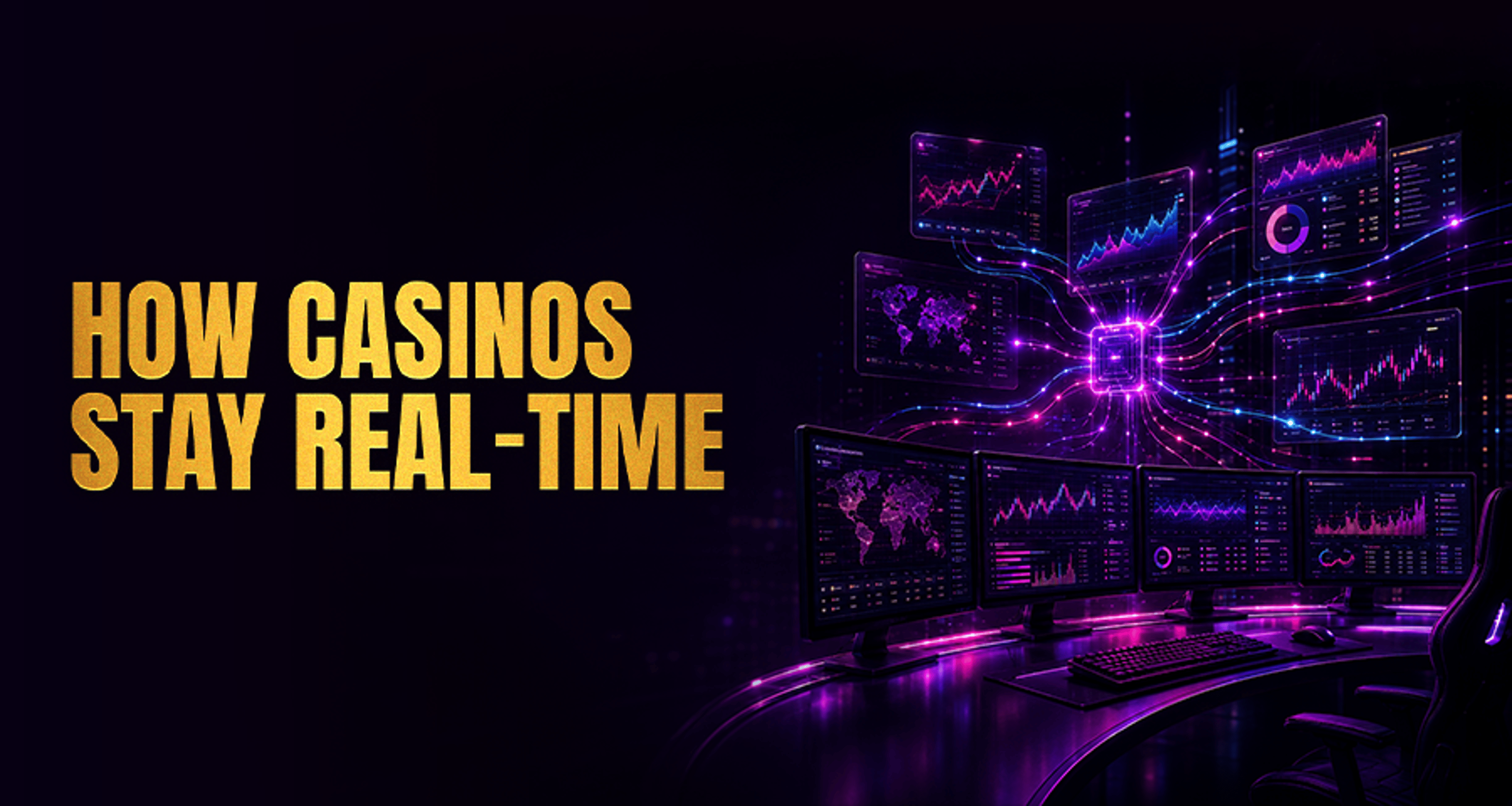
Real-time odds and data feeds are a core part of modern casino system infrastructure. They help operators keep live markets current, align front-end displays with live event states, and maintain pricing consistency across web, mobile, and backend services.
For platform teams, real time odds data feeds are not about tracking individual bets or monitoring player behavior. They are about moving live pricing and event data through a system accurately, quickly, and reliably.
In live environments, even small delays can create visible inconsistencies. A market may remain open too long, odds may differ across interfaces, or settlement logic may rely on stale event states. That is why operators treat real-time odds and data feeds as an operational dependency tied directly to uptime, integrity, and user experience.
What are real-time odds and data feeds in casino systems?
A real-time odds and data feed is a continuous stream of structured information delivered from one or more upstream sources into a casino or live gaming platform. Depending on the product, that information can include:
Price updates for betting or side markets
Match, round, or game-state changes
Market suspension and reopening signals
Score, timer, and event metadata
Settlement-triggering outcomes
Availability updates for live content or tables
In practice, operators use real-time odds and data feeds to power live odds displays, synchronize market states, and support downstream functions such as settlement, alerts, and operational monitoring. The key requirement is that the platform receives updates quickly enough, and validates them carefully enough, to avoid inconsistencies.
It is also useful to separate odds feeds from broader data feeds. Odds feeds are mainly concerned with pricing, market status, and outcome-related updates. Broader data feeds can include live game-state events, metadata, table availability, or content status signals that support the wider casino platform even when no price is changing.
How real-time data moves from source providers to casino platforms
Most casino systems do not generate all live odds or event data internally. Instead, they connect to external providers, then normalize and distribute that data through internal services.
A typical flow looks like this:
1. Source providers generate the upstream data
These may include odds suppliers, live game studios, event data companies, or specialist market providers. Each source may publish updates in a different format and at a different cadence.
2. An aggregation layer standardizes incoming feeds
Operators or platform vendors often run a middleware layer that maps provider-specific schemas into a common internal model. This reduces dependency on any one source format and makes downstream services easier to maintain.
3. APIs, streams, or webhooks distribute updates internally
Once normalized, data is passed to pricing services, trading controls, front-end applications, and operational dashboards. Some systems use pull-based APIs for snapshots or reconciliation, while latency-sensitive products rely on push-based delivery for live changes.
Once normalized, data is passed to pricing services, trading controls, front-end applications, and operational dashboards. Some systems use pull-based APIs for snapshots or reconciliation, while latency-sensitive products rely on push-based delivery for live changes.
4. Front-end delivery updates user-facing interfaces
Web and app clients consume the latest valid state so that odds, event status, and market availability stay aligned with backend truth.
5. Monitoring services track data quality and delivery health
Operators watch for lag, dropped updates, mismatched states, or abnormal provider behavior before those issues affect market integrity.
This feed pipeline is closely related to broader operational visibility, but it is not the same thing. For adjacent reading on platform oversight, HunnyPlay’s guide to real-time gambling monitoring is best treated as a companion topic on monitoring and controls rather than a duplicate of feed architecture.
Why latency and synchronization matter for live odds accuracy
Latency affects more than speed. In live casino and odds-driven environments, it affects whether the displayed state matches the actual event state.
If one service receives an update later than another, several problems can appear:
Front-end odds display lags behind the trading or source state
A market stays open after it should be suspended
Different clients show different prices for the same event
Settlement services evaluate outcomes using stale data
Internal alerts trigger too late to prevent exposure
Synchronization matters because most casino systems are distributed. Real-time odds data feeds may pass through ingestion services, caching layers, frontend APIs, mobile delivery channels, and settlement engines.
If those components are not working from the same sequence of updates, operators can end up with inconsistent market behavior.
A practical example is cross-surface pricing consistency. If a suspension or price change reaches the web client before the mobile API cache refreshes, two users may briefly see different states for the same market.
To prevent that, operators typically distribute versioned updates from a single normalized source of truth, invalidate stale cache entries quickly, and require each client surface to confirm it is rendering the latest accepted market version before showing odds.
A simple failure example makes this clearer: a source provider sends a suspension signal for a live market, but a stale cache on the frontend keeps the previous odds visible for a few extra seconds.
Even if the backend has already stopped accepting updates, the mismatch creates confusion, raises support risk, and complicates incident review.
To reduce this risk, platforms typically use:
Timestamped events
Sequence numbers or versioning
Ordered message handling
Cache invalidation rules
Health checks on update freshness
Automatic suspension when feed confidence drops
Key infrastructure components behind reliable odds delivery
Reliable real-time odds and data feeds usually depend on several core components working together.
Source providers
These are the origin points for live odds, event states, or table-level game data. Operators often assess providers based on coverage, update speed, format quality, historical reliability, and incident response.
Aggregation and normalization layer
This layer transforms different provider formats into a unified internal structure. It also helps with deduplication, conflict handling, and routing updates to the right downstream systems.
APIs, streams, and webhooks
Delivery methods vary by use case. Streaming connections are often preferred for fast-moving live updates, while APIs may support snapshots, reconciliation, or backfill. Webhooks can be useful for event-driven changes where immediate push matters.
It also helps to separate transport-level delivery from state reconciliation. Transport determines how updates arrive in the first place, such as a stream, webhook, or API response.
Reconciliation determines how the platform restores the correct state after a disconnect, dropped message, or delayed client refresh. Mature systems need both: fast delivery during normal operation and a reliable way to confirm the current market state after interruptions.
Front-end distribution layer
Odds and event updates need to reach websites, mobile apps, or operator consoles without introducing additional lag. This often involves cache design, session-aware delivery, and careful rendering logic for partial updates.
Where UI categorization matters, related content models and game taxonomy can also influence how markets are grouped and displayed across products, similar to how a casino game style guide shapes presentation logic at the content layer.
Monitoring and alerting
Monitoring is essential for detecting stale feeds, gaps in event progression, failed retries, or conflicting market states. Operators also watch provider-level performance over time to understand where instability originates.
Settlement and reconciliation logic
Reliable feed architecture does not end when the event finishes. The same data path must support consistent settlement outcomes, post-event validation, and correction workflows if discrepancies appear.
How operators manage feed failures, delays, and data mismatches
No live data environment is perfect, so operators build controls around expected failure modes.
Redundancy
A common approach is to maintain backup providers, secondary routing paths, or fallback data states. If the primary source becomes unavailable, the platform can suspend affected markets or switch to a validated alternative depending on internal policy.
Data validation
Operators validate incoming updates against schema rules, logical thresholds, event sequencing, and known market states. If a provider sends a malformed or contradictory update, the platform should flag or quarantine it before it reaches the frontend.
Suspension logic
When confidence in the incoming feed drops, temporary suspension is often safer than continuing to display uncertain prices. This protects pricing consistency and reduces the chance of front-end and backend drift.
Reconciliation workflows
After an incident, teams compare source data, internal logs, and settlement records to identify where divergence occurred. This helps restore consistent records and improve future resilience.
Snapshots, backfill, and replay
Dropped messages and reconnect events are common enough that mature systems plan for them explicitly. Snapshot endpoints can provide the latest known full state after a disconnect, while backfill or replay functions help recover missed updates in sequence.
This is especially useful when an operator needs to rebuild a market state without assuming that the live stream alone remained complete.
Operational observability
Teams need visibility into message delay, missing updates, retry behavior, failover events, and service-level degradation. Strong observability shortens response time and helps distinguish a provider issue from an internal distribution issue.
Technical foundations such as authenticated transport and trusted service communication also matter, which is why some teams review supporting concepts like public key cryptography explained in simple terms when evaluating secure provider-to-platform connections.
What to evaluate when choosing a real-time odds data provider
Vendor selection is not only about who offers the most events. Operators usually compare providers across several operational criteria:
Update speed: How quickly are odds and event changes published?
Uptime history: How stable is the feed during peak live periods?
Coverage depth: Does the provider support the required sports, tables, games, or market types?
Data structure quality: Are schemas consistent, documented, and easy to integrate?
Fallback support: Are backup channels, replay tools, or recovery workflows available?
Monitoring visibility: Can the provider expose status pages, timestamps, lag signals, or incident notifications?
Settlement reliability: Is outcome data consistent enough for dependable post-event processing?
Integration fit: Does the provider work well with the operator’s existing aggregation and delivery stack?
Operators should also look closely at the integration model itself.
Important questions include whether the provider is primarily push-based or pull-based, how schema versioning changes are announced, how clear the documentation is for implementation teams, what service-level expectations are defined, and how quickly change-management or incident updates are communicated when something breaks.
In production, these details often matter more than a broad coverage list.
Sportsbook-style odds feeds, live game event feeds, and internal analytics are not the same thing
Operators often group multiple live data systems together, but they serve different purposes and are implemented differently.
Sportsbook-style odds feeds
These feeds primarily deliver pricing updates, market availability, suspensions, and outcome-related data. They are usually structured around high-frequency market changes, versioned price states, and fast distribution into trading or display services.
Live game event feeds
These feeds focus more on gameplay state than on pricing. They may carry timer updates, round progression, score changes, table events, or dealer/game-state signals.
In implementation terms, they often depend on event sequencing, session state tracking, and synchronization with front-end presentation layers rather than continuous price recalculation.
Internal platform analytics
These are generated inside the operator environment to measure performance, uptime, latency, conversion, or operational patterns. Analytics help teams evaluate system behavior, but they are not the same as upstream odds or event feeds.
Keeping these layers separate improves architecture clarity and helps teams assign the right controls to the right systems.
How this topic differs from real-time gambling monitoring
Real-time odds and data feeds focus on infrastructure that moves pricing and event information through a casino system. Real-time gambling monitoring, by contrast, is an adjacent operational layer concerned with observing platform activity, controls, and system behavior from a monitoring or oversight perspective.
That distinction matters. This article is about:
Data ingestion
Feed normalization
Latency handling
Synchronization
Failover and redundancy
Settlement consistency
It is not about tracking individual player behavior or surveillance. Operators looking at the broader operational picture may treat monitoring as a separate companion topic alongside feed architecture, not as the same function.
Conclusion
Real-time odds and data feeds are a foundational layer in live casino and gaming systems. They connect external providers to internal platform services, keep odds and event states aligned, and support consistent market availability across the stack. When feed quality drops or update flow breaks, the impact can quickly reach settlement accuracy, incident response, and user experience.
For operators, the main takeaway is practical: fast updates only matter when every downstream surface can trust and reconcile the same current state. That makes validation, redundancy, recovery, and observability just as important as raw delivery speed.
For more HunnyPlay insight into casino platform operations, live system monitoring, and data-driven performance infrastructure, explore related Operator Insights coverage.
FAQ
What is a real-time odds data feed in an online casino system?
It is a continuous stream of live pricing and event-related data that helps a casino platform update odds, market states, and settlement inputs in near real time.
How do casino platforms keep live odds updated instantly?
They use upstream providers, aggregation layers, push-based delivery methods, caching controls, and monitoring systems to distribute validated updates quickly across backend and frontend services.
Why does latency matter in real-time odds delivery?
Latency can cause outdated odds, delayed market suspension, inconsistent displays, and settlement issues if different parts of the platform receive updates at different times.
What happens if an odds feed goes down during live play?
Operators typically suspend affected markets, switch to backup paths if available, use snapshot or replay tools to recover state, and run reconciliation processes later to confirm data integrity and settlement consistency.
Are odds feeds the same as player activity monitoring tools?
No. Odds feeds deliver pricing and event data for market operations, while monitoring tools focus on platform oversight, alerts, and operational visibility.
What should operators look for in a real-time data provider?
They should evaluate update speed, uptime, coverage, schema quality, fallback support, monitoring visibility, settlement consistency, documentation quality, and how well the provider communicates versioning or incident changes.