What Makes a Crypto Casino UI Feel “Smooth”?
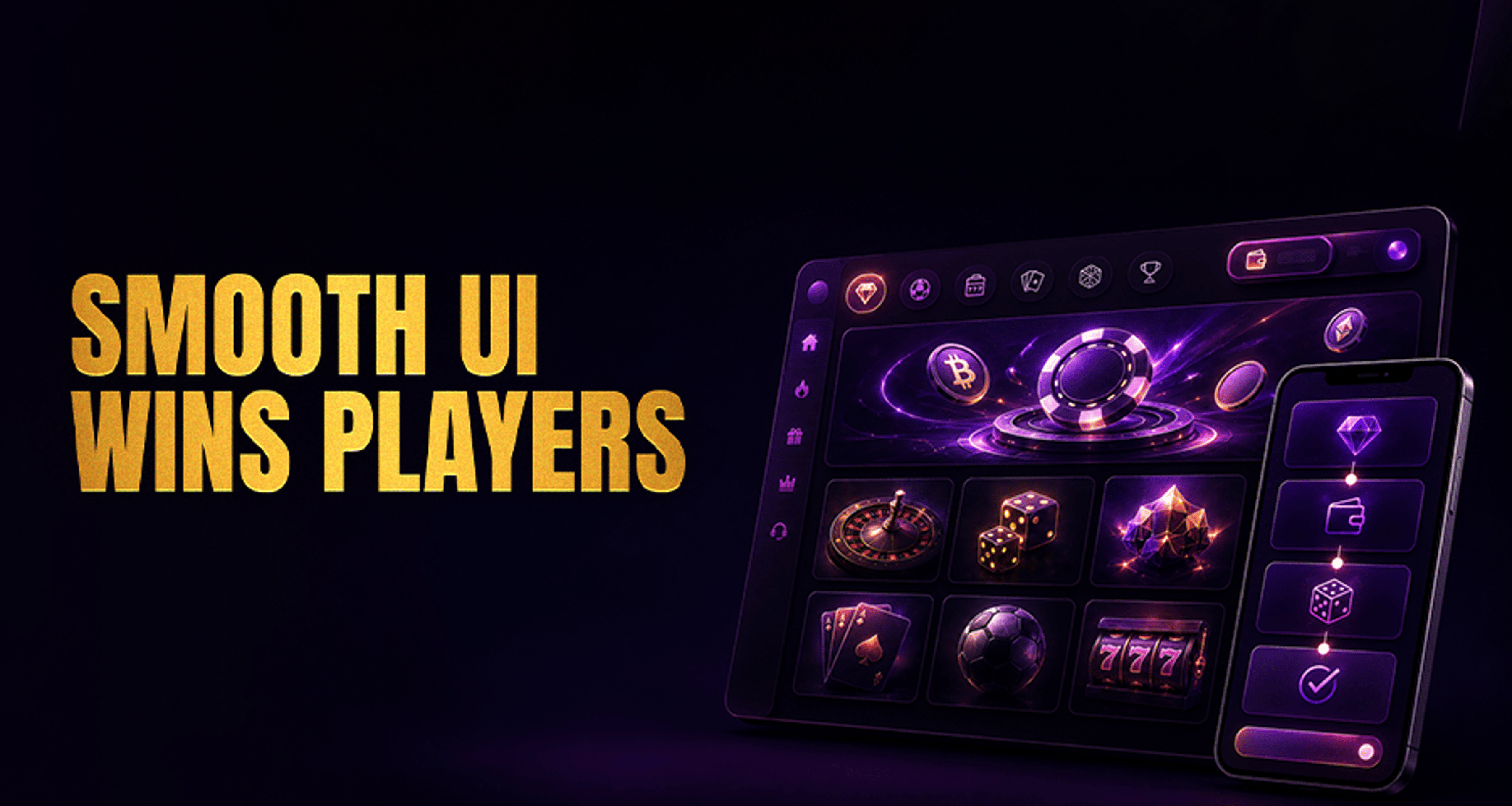
A smooth crypto casino UI does not happen by accident. Players notice it in the first few seconds: the lobby loads quickly, the wallet flow feels obvious, mobile navigation stays clear, and every interaction feels consistent rather than noisy.
For operators, that matters because a polished interface shapes the full crypto casino user experience. It affects how easily players can browse games, move between categories, connect a wallet, and complete routine actions without hesitation. In other words, a smooth casino UI is less about visual effects and more about reducing friction at every step.
This is also where it helps to separate UI from UX. Casino UI refers to the visible layer: layout, buttons, menus, typography, spacing, motion, and visual hierarchy. Casino UX is the broader experience created by those choices, including speed, clarity, trust cues, and task completion. When operators get both right, the product feels effortless.
Smooth UI Starts With Fast Understanding
The best casino interfaces help players understand the product immediately. A premium dark visual style can look sharp, but it only feels smooth when the design supports fast decisions.
That usually means:
Clear navigation from the first screen
A visible distinction between featured content and supporting content
Strong contrast for buttons, balances, and game categories
Simple labels that reduce guesswork
A layout that feels stable across desktop and mobile
If players need to pause and decode the lobby, the interface is already creating drag. This is especially important in crypto environments, where users may already be balancing wallet connection, token choice, and network awareness.
Navigation Should Feel Light, Not Busy
A common mistake in casino design is trying to show everything at once. Too many categories, banners, icons, or floating prompts can make the interface feel crowded rather than helpful.
A smoother crypto casino UI keeps the user moving with minimal mental load. Categories should be easy to scan. Search should be easy to find. Filters should narrow the choice set without creating a second layer of confusion. Operators looking at crypto casino game UX patterns can see how game discovery often improves when navigation systems are simplified instead of expanded.
The same principle applies to promotional surfaces. Featured placements should guide attention, not compete with the core user journey. If every tile is trying to be the main event, nothing feels prioritized.
Wallet and Payment Flow Are Part of the Interface
Players do not experience the wallet flow as a separate system. They experience it as part of the product. That means deposits, balance visibility, token selection, and confirmation states all shape whether the platform feels smooth or clumsy.
A strong interface makes wallet actions predictable:
The connect button is easy to find
Supported assets are presented clearly
Balances update in an understandable way
Confirmation states feel calm and informative
The user always knows what happens next
For example, imagine a mobile player opening the site, connecting a wallet, and attempting a deposit. If the network selector is hidden, the confirmation state is vague, and the page jumps after submission, the product feels fragile. If the same flow presents each step clearly with stable spacing and obvious feedback, the experience feels controlled. That is a direct UI win.
Operators refining these flows often benefit from reviewing adjacent patterns in crypto casino cashier design, where wallet clarity and transaction guidance have a major impact on usability.
Motion, Feedback, and Responsiveness Matter More Than Flash
Smoothness is often associated with animation, but motion alone does not create polish. In fact, excessive animation can slow users down.
What matters more is responsive feedback:
Buttons react immediately
Loading states are visible but unobtrusive
Hover and tap states confirm interaction
Page transitions feel clean rather than abrupt
Errors are specific and easy to recover from
A premium dark style works best when motion is restrained. Small transitions, subtle highlights, and consistent response timing tend to feel more refined than dramatic effects. For operators studying online casino design trends, the strongest lesson is usually not “add more visuals,” but “make the interface react with confidence.”
Mobile Is Where Smoothness Gets Tested
Many casino interfaces look polished on desktop and fall apart on mobile. That is where spacing, tap targets, sticky navigation, and panel behavior become critical.
A smooth casino UI on mobile should make it easy to:
Return to the lobby
Switch categories without losing context
Open a game without accidental taps
View balances and wallet controls without hunting for them
Close overlays and resume browsing quickly
This is also where inconsistent hierarchy becomes obvious. If banners dominate the screen, menus require too many taps, or the wallet state is hidden behind multiple layers, users feel friction immediately.
What Operators Should Audit in a Crypto Casino User Experience
One useful way to review a crypto casino user experience is to audit it as a sequence of micro-decisions rather than a visual presentation.
A practical operator checklist includes:
First-screen clarity: Can a new visitor understand where to browse, search, and connect a wallet within seconds?
Lobby readability: Are categories, featured games, and promotional blocks clearly prioritized?
Wallet flow stability: Does each step of connect, select, confirm, and return feel predictable?
Mobile control: Are taps, drawers, overlays, and sticky elements easy to use with one hand?
Recovery quality: If a user hits an error, can they fix it without confusion or restarting the task?
This kind of review creates stronger operator insight than asking whether the site simply “looks modern.” A design can appear current and still create friction in the moments that matter most.
Common Failure Patterns That Break the Feeling of Smoothness
The fastest way to lose polish is to interrupt momentum. In practice, the most common failure patterns are:
Overloaded lobbies with weak visual hierarchy
Wallet actions that feel detached from the rest of the interface
Inconsistent button behavior across pages
Aggressive pop-ups that interrupt browsing
Filters or menus that hide the next obvious action
Mobile overlays that trap the user or obscure key controls
These issues rarely look dramatic in isolation. Together, they make the platform feel less trustworthy, less refined, and harder to use.
A Smooth Casino UI Feels Effortless Because It Removes Friction
What makes a crypto casino UI feel smooth is not just aesthetics. It is the combination of clarity, speed, consistency, and responsive design choices that help users move without hesitation.
For operators, the real benchmark is simple: can players browse, connect, decide, and act without feeling slowed down by the interface? When the answer is yes, the design feels premium. When the answer is no, even the best visual style cannot fully compensate.
In that sense, a smooth crypto casino UI is really a friction-management system. The better the interface handles discovery, wallet interaction, feedback, and mobile behavior, the more natural the entire experience becomes.