Why Casino Withdrawal Fees Differ by Coin and Network?
Crypto casino withdrawal fees are not determined by casino policy alone. In most cases, the total cost depends on three moving parts: the blockchain fee, the casino’s.
Crypto casino withdrawal fees are not determined by casino policy alone. In most cases, the total cost depends on three moving parts: the blockchain fee, the casino’s own processing setup, and any costs charged by the wallet or exchange receiving the payout.
That is why casino withdrawal fees differ by coin network instead of staying flat across every crypto option.
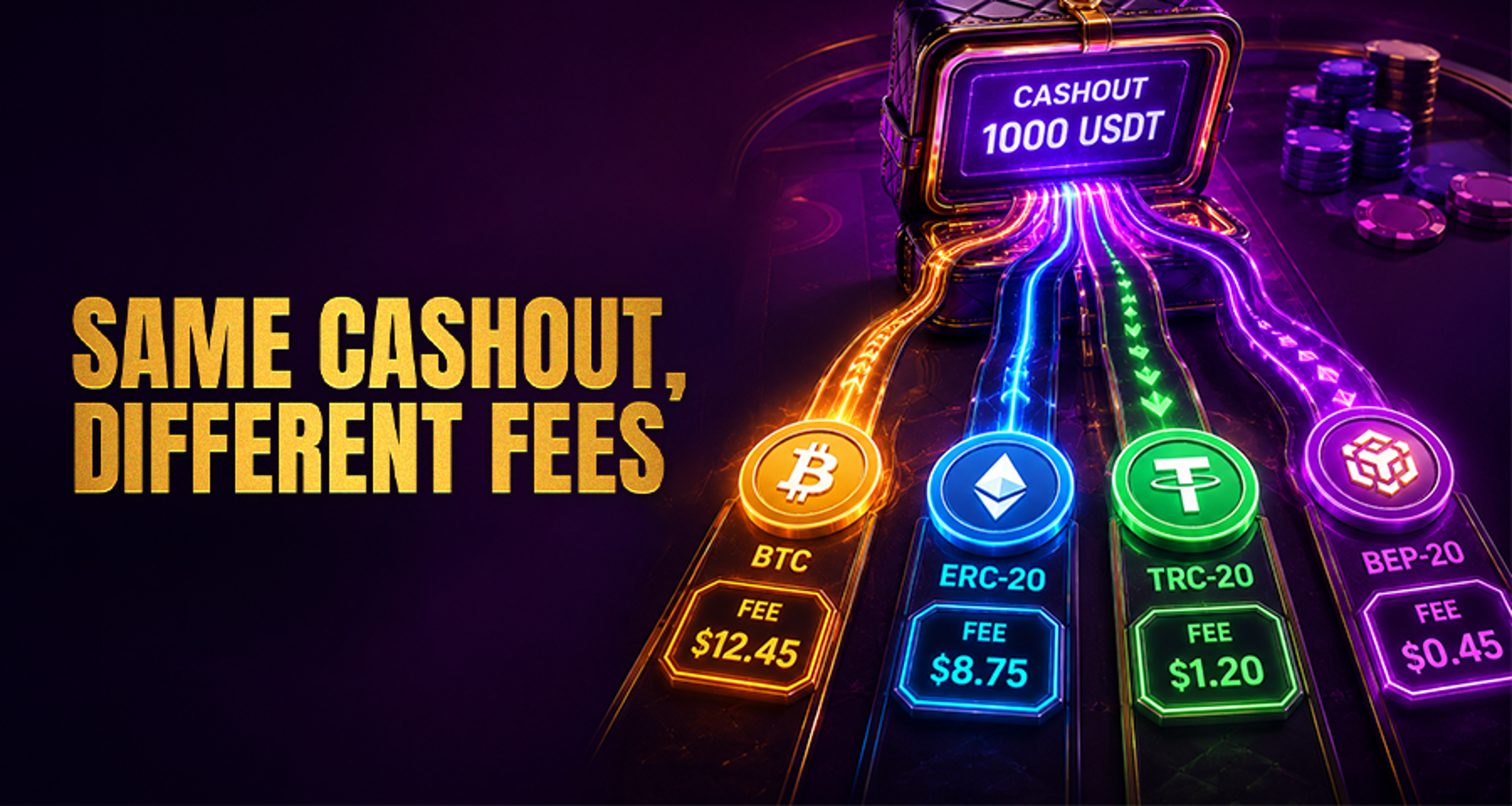
For players, the practical takeaway is simple: the same withdrawal value can cost more or less depending on both the coin and the blockchain rail used to send it. A Bitcoin payout, a USDT payout on ERC-20, and a USDT payout on TRC-20 may all reach the same destination in different ways, with different cost patterns, speed tendencies, and compatibility risks.
If you want a broader view of how payout options compare beyond crypto alone, it helps to review casino payment methods and how they compare for speed, safety, and fees.
Why casino withdrawal fees change from one coin to another
Different cryptocurrencies run on different networks or have different fee structures built into their ecosystems. That means a casino cannot process every coin at the same underlying cost.
A few common reasons fees change from one coin to another include:
Different blockchain designs: Bitcoin, Ethereum, Tron, and BNB Smart Chain do not process transactions the same way.
Different network demand: Some chains become expensive when usage spikes, while others tend to stay lower-cost more often.
Different token handling requirements: Native coins and tokens can create different operational steps for the casino.
Different payout policies: A casino may batch transactions, absorb part of the cost, or add a fixed handling fee depending on the route.
So when users wonder why a BTC cash-out costs more than a stablecoin withdrawal, or why one token seems cheap on one rail but not another, the answer usually starts with the blockchain itself rather than an arbitrary pricing decision.
Why the same crypto can have different fees on different networks
This is where many players get caught out. The same asset can exist on multiple supported networks, and each route can behave very differently.
Take USDT as the clearest example:
USDT on ERC-20 uses the Ethereum network
USDT on TRC-20 uses the Tron network
USDT on BEP-20 uses BNB Smart Chain
Although the asset is still USDT, the transfer does not move through the same blockchain. Each network has its own transaction costs, congestion patterns, confirmation speed, and wallet support.
That is why the casino may show different withdrawal fees for the same USDT balance depending on which network you choose. The difference is not just branding or labeling. It reflects a genuinely different payout rail.
This is also why the cheapest option is not always the best one. If your wallet or exchange only supports ERC-20 deposits for USDT, choosing a cheaper TRC-20 or BEP-20 withdrawal can create a serious compatibility problem.
What actually makes up a crypto casino withdrawal fee
When comparing withdrawal costs, it helps to separate the total into three fee layers.
1. Blockchain or network fee
This is the cost of sending the transaction on-chain. It is influenced by the network being used, how busy it is, and how the payout is structured. On some chains, this cost can rise sharply during congestion. On others, it may stay relatively low more often.
2. Casino processing fee
Some casinos add their own fixed or semi-fixed fee on top of the blockchain cost. Others may bundle the network charge into a single visible withdrawal fee. In some cases, the platform may batch withdrawals or manage wallet operations in a way that changes what the player sees.
This matters because two casinos can support the same coin and network but still display different payout costs due to internal processing choices.
If you are also trying to understand the platform side of payout friction, see why casino withdrawals get delayed, since timing and operations can affect the full withdrawal experience.
3. Receiving wallet or exchange costs
The fee shown by the casino is not always the end of the story. Your receiving wallet or exchange might:
Charge a deposit or handling fee
Require a minimum deposit amount
Credit funds more slowly on certain networks
Support only selected token standards
That means the “cheapest” withdrawal option at the casino level may not be the cheapest end-to-end route after the funds arrive.
Coin and network examples: BTC vs ETH vs stablecoin rails
Here is a practical way to think about common payout routes.
BTC withdrawals
Bitcoin withdrawals are often straightforward and widely supported, but fees can feel heavy on smaller payouts. When network demand rises, the cost of getting a transaction confirmed can increase. That makes BTC less efficient for small withdrawals even when it remains a familiar and trusted option.
ETH withdrawals
ETH payouts on Ethereum can become costly when network activity is high. This is especially relevant when a casino pays out via the Ethereum mainnet, where gas costs can move around significantly. Even when the payout is simple, Ethereum congestion can make the route less attractive for cost-sensitive users.
Stablecoins on ERC-20
Stablecoins such as USDT or USDC on ERC-20 can be convenient because of broad wallet and exchange support, but they may inherit Ethereum’s higher fee behavior. That makes them useful for compatibility, though not always ideal for minimizing cost.
Stablecoins on TRC-20
TRC-20 stablecoin withdrawals are often chosen because this rail is frequently lower-friction than Ethereum-based alternatives. That said, support varies by casino and destination wallet, so users still need to verify compatibility before selecting it.
Stablecoins on BEP-20
BEP-20 can also offer a lower-cost route in many cases, but it comes with the same caution: lower fee visibility does not matter if the receiving platform does not support that network for the asset you are sending.
If you want a more focused look at payout-saving habits, this guide to reducing crypto casino withdrawal fees is a useful companion read.
How network congestion and payout size affect what you pay
Withdrawal fees are not static. Even on the same coin and network, the cost can change over time.
Congestion and demand
When a blockchain gets busy, transactions compete for space. That pushes network fees up. A withdrawal that looked reasonable earlier in the day may become less efficient during a high-demand period.
Batching and processing windows
Some casinos process withdrawals individually, while others batch multiple withdrawals together. Batching can improve operational efficiency, but it may also affect timing and how fees are presented to users.
Small withdrawals and minimums
Withdrawal minimums matter because they amplify the pain of fees on small cash-outs. A fee that seems manageable on a large withdrawal can take a noticeable share of a smaller payout. That is one reason players should always compare the net amount received, not just the listed fee.
How to choose the cheapest safe withdrawal option
The cheapest safe option is usually the supported coin and network combination that balances cost, speed, and compatibility.
Use this checklist before requesting a payout:
Check which networks the casino supports for that asset. Do not assume every USDT withdrawal option is available.
Confirm which network your receiving wallet or exchange accepts. Match the exact rail, not just the coin name.
Compare fee behavior, not just labels. A fixed fee, a variable network fee, and a receiving-side cost can produce very different outcomes.
Consider timing. If fees are clearly elevated due to congestion, waiting may help.
Consolidate carefully. Fewer withdrawals can reduce repeated fixed charges, but only if you are comfortable with timing and threshold requirements.
Review the minimum payout amount. High minimums plus high fees are especially inefficient for smaller balances.
HunnyPlay users should review the available withdrawal methods, network options, limits, and listed fees before cashing out so they can choose the most cost-efficient supported route.
Mistakes to avoid before confirming a crypto withdrawal
A few errors cause most avoidable fee problems:
Choosing a network only because it looks cheapest without checking wallet or exchange support
Ignoring minimum withdrawal thresholds on smaller balances
Assuming the casino controls the entire fee when much of the cost may come from the blockchain
Forgetting receiving-side restrictions such as supported token standards or deposit requirements
Comparing coins without comparing rails even though network selection may be the real cost driver
The biggest warning is simple: cheapest is not always best. A lower-fee network is only useful if the destination can receive that exact asset on that exact chain.
Conclusion
Casino withdrawal fees differ by coin and network because crypto payouts are shaped by more than one rulebook. The blockchain used, the casino’s payout process, and the receiving platform’s requirements all influence the final cost.
For players, the smartest approach is to compare the full route before withdrawing: coin, network, visible fee, likely speed, minimum threshold, and destination compatibility. That makes it much easier to avoid inefficient payout choices and keep more of the amount you are withdrawing.
FAQ
Why is USDT withdrawal cheaper on one network than another?
Because USDT can be sent across different blockchains, and each network has its own fee structure, congestion pattern, and processing behavior. USDT on ERC-20, TRC-20, and BEP-20 may all represent the same asset, but they do not cost the same to move.
Do casinos set crypto withdrawal fees or does the blockchain?
Usually both play a role. The blockchain creates the underlying network cost, while the casino may add its own processing fee or display a bundled withdrawal charge.
Why does Bitcoin withdrawal sometimes cost more than stablecoin withdrawals?
Bitcoin network conditions, payout size, and the structure of the withdrawal can make BTC less efficient for smaller transfers. Stablecoins on lower-cost rails may sometimes create less fee pressure, though that depends on support and network conditions.
Can the same casino charge different fees for the same coin on different networks?
Yes. If the same asset is offered on multiple rails, such as USDT on ERC-20 and TRC-20, the casino can show different fees because the underlying blockchain costs and processing requirements differ.
How can I reduce casino crypto withdrawal fees safely?
Check supported networks first, choose a compatible lower-friction route where appropriate, avoid withdrawing during obvious congestion, review minimum thresholds, and confirm that your destination wallet or exchange supports the exact network you plan to use.